
Written by: Dr. Mitch Javidi & Doc Shauna Springer, Ph.D.
In our recent book, Elastic Identity (with Jeff Kingsfield, 2025), we explored how leaders and individuals thrive when their identities are flexible rather than rigid. That work sparked a continuing dialogue between us about how elasticity applies across psychology, leadership, and human performance.
One of the concepts that surfaced in our latest exchange was Freud’s idea of cathexis, the way we invest emotional or psychic energy into people, ideas, and roles. Freud argued that much human struggle stems from our inability to withdraw this energy from draining sources and reinvest it where growth can happen.
As a human performance and leadership expert, Mitch often sees some leaders locked into failing strategies that consume their vitality. As a clinical psychologist, Shauna encounters clients who remain bound to past traumas, toxic relationships, or rigid roles. From these different vantage points, we noticed the same truth from our different lenses: where we invest our energy defines our capacity to grow as we study and practice at MAGNUS | ONE.
The following is a conversation, born over coffee, and extended from our work on Elastic Identity, about how Freud’s cathexis can be reimagined through the lens of the Elastic Self.
*****
Mitch: Over coffee not long ago, we found ourselves circling back to the themes we had recently written about in Elastic Identity with our colleague Jeff Kingsfield. That book explored how rigid identities can trap leaders and organizations, while elastic identities expand capacity and resilience.
Shauna: Right, and in that conversation, we pushed the idea further. We asked: what if we apply the same lens to Freud’s notion of cathexis, the way we invest our emotional energy? That question turned our coffee into a working session on the next frontier of elasticity.
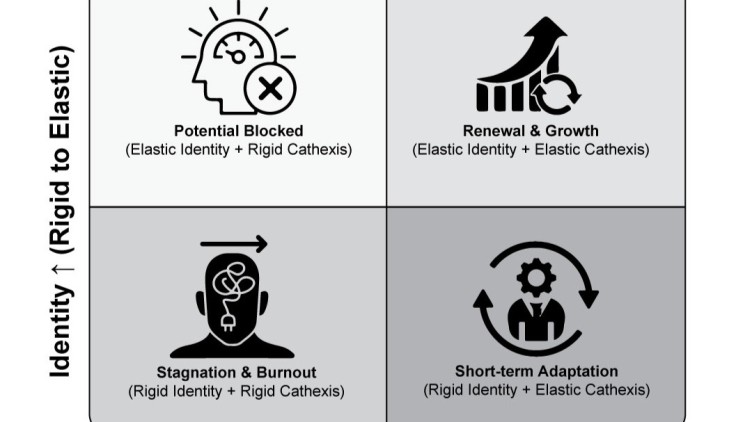
Shauna: Freud described cathexis as the psychic energy we invest in people, ideas, or roles. In my clinical work, I see clients whose energy is rigidly cathected, locked into past losses, toxic relationships, or unyielding roles. They can’t move forward because their energy remains trapped.
Mitch: And in leadership, I see the same. Executives and organizations cling to outdated strategies or overcommit to failing projects. Their energy stays bound in structures that no longer produce growth.
Shauna: Which brings us to the Elastic Self. Elastic cathexis is the ability to withdraw energy from what drains and reinvest it where it nourishes.
Mitch: Exactly. It’s not about indifference or detachment. It’s about making conscious reinvestments, knowing when to pivot, and having the courage to reallocate energy into growth, relationships, and purpose.
Mitch: In human performance and leadership science, I see leaders stall not because they lack vision, but because they over-invest in dead-end strategies. Elastic cathexis gives them permission to release energy without shame and reinvest with purpose.
Shauna: In my clinical work, I see how people struggle to withdraw cathexis from past pain. Post-traumatic growth happens when energy is reclaimed and reinvested into meaning. That’s as true for organizations as it is for individuals.
Mitch: Which means leaders who lack elasticity inevitably mirror their rigidity onto their teams. They cling to toxic partnerships. They double down on declining systems. They exhaust themselves and their people.
Shauna: Elastic leaders do something different. They withdraw wisely, seeing clearly when investment no longer yields growth. They reallocate elastically, shifting energy toward opportunities that strengthen purpose. And they model renewal, showing that letting go is not failure, but an act of wisdom.
Mitch: In organizational coaching, I worked with a leader who couldn’t let go of a declining division. Once they withdrew their cathexis and reinvested into emerging technologies, the organization renewed its growth.
Shauna: That’s mirrored in therapy. I’ve worked with veterans who felt bound to past traumas. Through therapeutic processes, they withdrew energy from reliving the event and reinvested it into relationships, mentoring, and community work. They didn’t erase pain, but they expanded their lives.
Mitch: Whether in a boardroom or in a clinical setting, the principle is the same: energy must circulate. If it stagnates, growth halts. If it reinvests, resilience multiplies.
Shauna: When we wrote Elastic Identity with Jeff Kingsfield, we focused on how flexible identities build resilience. But this conversation extends that work. Cathexis is about where we place our energy. Elasticity gives us the freedom to move that energy when conditions change.
Mitch: And that’s the bridge, identity provides the vessel, but cathexis provides the flow. Together, they form a dynamic system for leaders and individuals to thrive.
Shauna: Elastic cathexis reminds us: the past doesn’t have to define our future investments. We can reclaim energy, reallocate it, and expand through renewal.
Mitch: That’s the next frontier of our work. And it started, as good things often do, with a simple cup of coffee.
Shauna: As a clinical psychologist, I’ve had the privilege of sitting with people at some of the most difficult crossroads of their lives, veterans navigating trauma, families rebuilding trust, and leaders rediscovering purpose. What I’ve learned is this: our lives expand or contract based on where we place our energy.
I’m reminded of a patient who remained locked in grief and regret for decades after returning from Vietnam. He had promised a fellow soldier that he would visit their families and share how deeply their loved one was cared for. For many reasons, he was never able to do this, and that unfulfilled promise became the weight of his shame.
During our work together, he realized it was not too late. He began contacting the families of his fallen brothers, making trips across the country to join them in remembrance and shared mourning. In doing so, he reconnected with the man he had lost, and with the world he thought he had left behind. That act of reinvestment transformed him. It pulled him from the tunnel of solitary grief into a broader landscape of connection.
Trauma binds us in isolation, blinding us to the faces and voices of those who still love us. I think of my friend Mike, a veteran and triathlete, who, like our co-author Jeff Kingsfield, now runs in honor of his fallen brothers, whether lost to combat or the silent war of the mind. Mike connects deeply with the Gold Star families of those he once called brothers. Many attend his endurance events; some even run alongside him, transforming grief into motion, pain into purpose.
These are just two among many examples of what it means to reallocate energy from a place of isolation toward connection and meaning. They show that elastic cathexis is not theory — it is a lived transformation.
Whether in a counseling room or a command staff meeting, the lesson remains the same: We are not defined by where our energy has been trapped, but by how elastically we choose to reinvest it.
