
A hospital can post a nursing position by morning. It can offer a sign-on bonus by lunch. It can roll out another resilience initiative before the quarter ends.
That question sits underneath the vacancy rate, the resignation, and the nurse who stays, picks up another shift, cares deeply for patients, and quietly starts looking for a way out.
Nurses do not leave because of one difficult day. They leave after enough days when the pressure has nowhere to go except through them.
Healthcare does not have a motivation problem. It has a capacity problem. The system is asking people to absorb pressure it has not learned how to carry.
The data is serious. The message behind it is more serious.
In 2025, hospital RN turnover was 17.6%. The national RN vacancy rate was 8.6%. One in three hospitals reported an RN vacancy rate of 10% or more, and the average hospital had 43 unfilled RN positions. NSI Nursing Solutions, 2026 National Health Care Retention & RN Staffing Report.
Those numbers become a shift with one more assignment. A missed meal break. A weary preceptor who still has patients to care for. A nurse manager trying to solve a staffing hole, a conflict, an incident report, and tomorrow’s schedule before going home.
.png)
The National Council of State Boards of Nursing found that 40% of RNs reported plans to leave the profession within five years. Its researchers identify short staffing and high workloads as central threats to sustainable workforce planning. NCSBN, 2024 National Nursing Workforce Study.
The nursing shortage cannot be solved by recruitment alone. A health system can recruit faster, pay more, and fill roles temporarily. But it cannot recruit its way out of an experience that drives good people to question whether they can remain.
Nurses are not asking for less purpose. They are asking for less preventable friction.
In AMN Healthcare’s 2025 survey, 75% of nurses said they remained satisfied with nursing as a career choice. Yet 58% felt burned out most days, 64% said compassion fatigue had affected their health, and only 39% expected to remain in their current position over the next 12 months. Eighty-one percent said flexible schedules would improve working conditions. The survey included 12,171 RNs and reported a margin of error of plus or minus one percentage point. AMN Healthcare, 2025 Survey of Registered Nurses.
.png)
The U.S. Surgeon General identifies excessive workloads, administrative burdens, limited say in scheduling, and lack of organizational support as workplace conditions that drive health-worker burnout. U.S. Department of Health and Human Services, Health Worker Burnout.
Resilience is necessary. Elasticity is the missing leadership standard.
Resilience asks whether a person can recover after pressure. Elasticity asks whether the organization can absorb pressure, adapt in real time, and return to safe function without damaging the people inside it. This distinction is grounded in The Elasticity Continuum by Mitch Javidi, Ph.D., and Jeff Kingsfield.
An organization built only around resilience notices strain after it has become absenteeism, turnover, conflict, error, or a difficult exit interview. An elastic organization recognizes strain while there is still room to act.
Recognizing the pressure isn’t enough.
We have to help nurses recognize what pressure is doing to them. But recognition is only the first step.
Then we have to help them regulate.
Think about a nurse who has just been screamed at by a patient or family member.
Her heart is racing. She’s angry. Maybe she’s shaken. But her shift doesn’t stop. There is another patient waiting. Another medication to give. Another decision to make. Another family walking up to the desk.
She may recognize exactly what is happening inside her. She may know, I’m overwhelmed. I’m angry. I’m carrying this with me.
But knowing it doesn’t automatically help her reset.
MAGNUS | ONE includes assessments within the app that help people recognize their patterns and better understand how they respond when pressure rises.
The point isn’t to give nurses another score or tell them what’s wrong with them. It’s to help them see what is happening earlier, while there is still an opportunity to do something about it.
Then comes Regulate Now.
Regulate Now gives people a way to pause, regulate their response, and reset in the moment.
Because sometimes the need isn’t tomorrow. It’s right now. Before walking into the next patient room. Before responding to the next family member. Before making the next decision. Before one terrible interaction becomes the emotional backdrop for the rest of the shift.
And there is an important distinction here.
We are not teaching nurses to tolerate abuse.
Hospitals and healthcare systems still have a responsibility to protect their people, address verbal and physical mistreatment, and create environments where abuse isn’t dismissed as “part of the job.”
Regulation doesn’t remove that responsibility. It gives the nurse something she can control in a moment when so much around her may feel outside of her control: her next response.
That is where this starts moving beyond traditional resilience.
Recognize: What is happening to me right now?
Regulate: What can I do right now so this moment doesn’t control the next one?
Become Elastic: Can I meet what comes next with more clarity, flexibility, and choice?
Resilience has traditionally taught us to recover from pressure and get back to baseline.
Elasticity asks us to go further.
Can we stay grounded enough under pressure to adapt? Can we widen our response instead of narrowing it? Can we come through difficult experiences with greater capacity for what comes next?
This ability to stay grounded while adapting is also informed by Elastic Identity by Mitch Javidi, Ph.D., Jeff Kingsfield, and Shauna Springer, Ph.D.
So telling a nurse to “be resilient” isn’t enough.
Help her recognize what’s happening. Give her a way to regulate in the moment. Then help her build the capacity to respond differently when pressure comes again.
Because the goal isn’t simply to bounce back to who you were before the pressure. The goal is to build the capacity to meet the next pressure differently.
That’s how we begin building an elastic workforce.
Workforce health and patient safety are the same conversation.
The World Health Organization reports that medication-related harm affects one in every 30 patients in healthcare, with more than one quarter of that harm considered severe or life-threatening. It identifies inadequate staffing, workflow disruption, communication breakdown, fatigue, burnout, and competency gaps as connected contributors to harm. World Health Organization, Patient Safety Fact Sheet.
The same system conditions that exhaust people also make excellent care harder to deliver.
The hidden loss happens at the bedside.
When experienced nurses are too depleted to teach, coach, and steady the people coming behind them, institutional knowledge does not transfer cleanly. New nurses may inherit the work, but not the confidence, judgment, context, or psychological safety that allows them to grow into it.
The old phrase, “nurses eat their young,” does not excuse harmful behavior. It explains the operating environment that allows it to repeat. The future of nursing depends on whether healthcare can transfer wisdom without transferring trauma.
What MAGNUS | ONE changes.
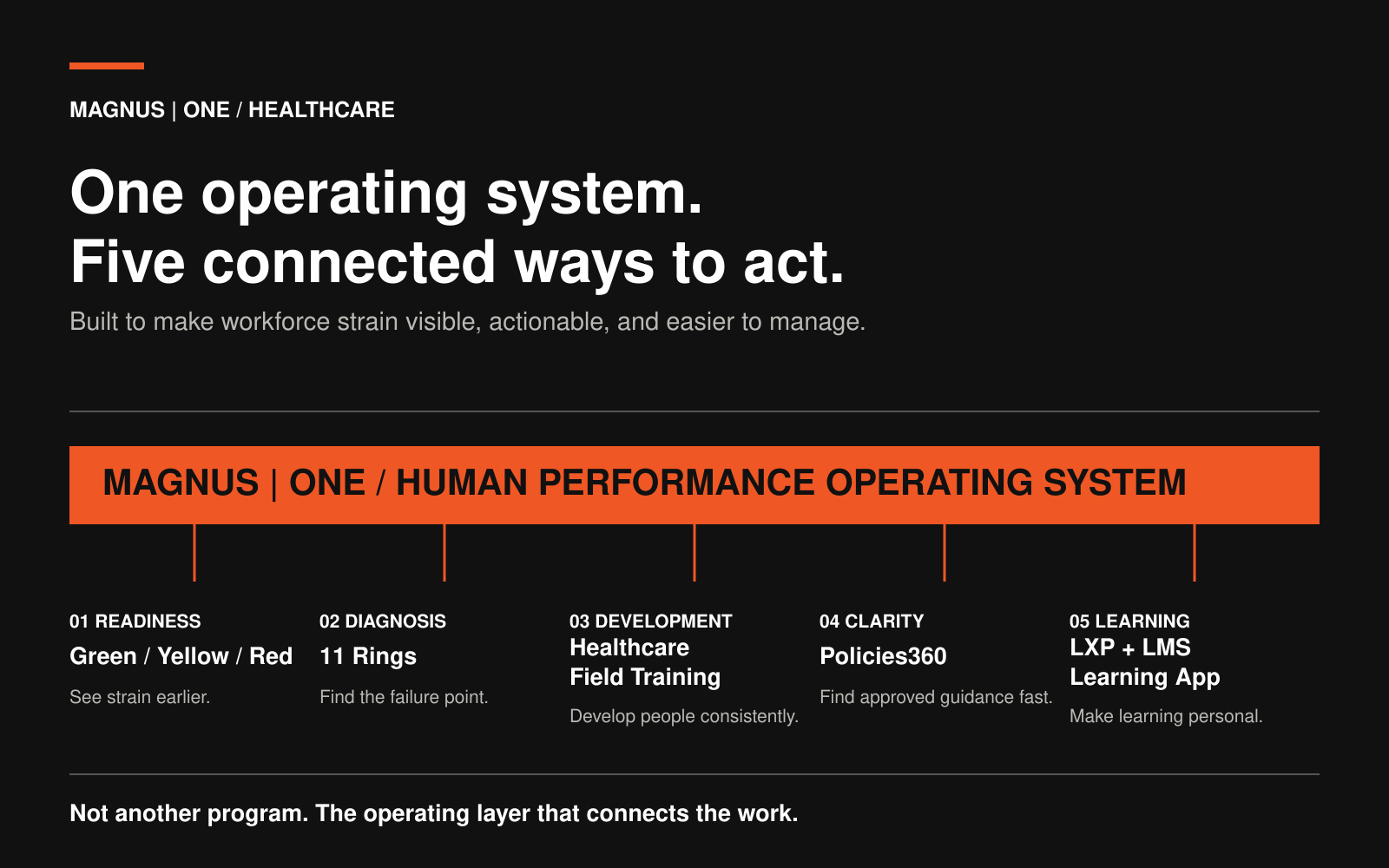
MAGNUS | ONE is not another wellness program, another survey, or another disconnected platform that asks already stretched people to do more. It is a human-performance operating system designed to help healthcare organizations see strain earlier, understand where it is coming from, and make response easier across the whole system.
A hospital’s own learning ecosystem, not another content library.
The planned healthcare version of MAGNUS | ONE gives a hospital its own Learning Experience Platform, delivered through a dedicated app. An LXP does more than house courses. It can recommend the next right resource based on an individual’s role, interests, skill gaps, behavior, and previous learning.
The experience can bring together courses, faculty-led instruction, author conversations, video, articles, coaching, assessments, microlearning, and other development resources in one place. Many of the same learning assets can also support the LMS version of the program.
|
Structured Learning
LMS
Standards, assignments, and completion.
|
Personalized Development
LXP
Relevant learning, recommended at the right time.
|
| Organization assigns the learning. | Learner discovers resources and receives recommendations. |
| Course-centered. | Experience-centered. |
| Tracks completion. | Tracks engagement and development. |
| Administrator-driven. | Learner-driven and personalized. |
| Primarily structured courses. | Courses, video, articles, coaching, assessments, and microlearning. |
| “You must complete this.” | “Here is what could help you next.” |
Authors and faculty can be central to that experience through direct teaching, live and recorded conversations, short learning moments, and practical reflections from the field. AI-generated video can also provide concise, role-specific learning in the formats people increasingly use. MAGNUS AI capabilities can extend the app further with contextual learning support and additional features shaped during product planning.
The test is simple: Does this make the work easier?
Hospital leaders have every reason to be skeptical of solutions that become another task, another login, another survey, or another expectation placed on clinicians and managers.
MAGNUS | ONE is designed to meet that test by connecting information instead of creating another silo, identifying strain before it becomes a crisis, making training more consistent, and bringing approved policy guidance closer to the moment of need.
What healthcare can choose now.
Hospitals cannot remove the complexity of modern healthcare. They cannot eliminate grief, urgency, clinical risk, or the emotional weight of caring for people on their hardest days.
But they can stop making avoidable friction part of the job. They can build organizations that see strain early, respond before damage accumulates, develop people consistently, make policy clarity immediate, and treat workforce health as a patient-safety responsibility.
- NSI Nursing Solutions. 2026 National Health Care Retention & RN Staffing Report. CY2025 data from 527 acute-care hospitals in 40 states, covering 965,886 healthcare workers and 262,405 RNs.
- National Council of State Boards of Nursing. 2024 National Nursing Workforce Study. Results published in 2025; 744,714 RN and 137,902 LPN/LVN respondents.
- AMN Healthcare. 2025 Survey of Registered Nurses. Workforce-company survey of 12,171 RNs; reported margin of error plus or minus 1%.
- U.S. Department of Health and Human Services, Office of the Surgeon General. Health Worker Burnout.
- World Health Organization. Patient Safety Fact Sheet.
- National Nurses United. The State of Workplace Violence in Health Care in 2025-2026. Survey of 1,267 RNs in 28 states and D.C., collected July 2025 through May 2026.
- Centers for Disease Control and Prevention. Symptoms of Anxiety or Depression and Burnout Among Health Workers. MMWR, 2023.
